Showing posts with label Reformed. Show all posts

Tuesday, October 29, 2019

Systematic Theology - A Review


Systematic Theology 


by
Robert Letham


A new comprehensive (1000+ pages) theology from an evangelical Presbyterian author should be well-received by the church at large.

At 1000 pages, the book is too large to read in its entirety before completing a review - it took three semesters in seminary to read through Augustus Strong’s Systematic Theology which is of similar length. What this review will attempt to do is examine three or four issues that may be of interest to a Wesleyan evangelical reader. The author of the review does not claim to be a theological scholar; but, rather, a pastor with an interest in theology.

The book begins, as a well-written theology must, with a discussion on the existence and nature of God. This includes an examination of the arguments often given for the existence of God. Letham points out these arguments are not likely to provide proof for the unbeliever, but they are “presented to believers to disclose the rationality of what they hold already by faith.” (p. 43). Letham looks at three of the most common arguments:

1. Anselm’s Proof for the Existence of God
                    (where he spends the most time)
2. The Cosmological Argument
3. The Teleological Argument
4. The Moral Argument

The author takes time to explore the strengths and weaknesses of such arguments as a whole. The discussion, as is the entire book, is well-documented with references to a variety of sources: Biblical, ancient, and modern.

After providing a detailed discussion of the Trinity, the author provides a full discussion on the attributes of God. From there the author moves into a discussion of the Word of God, quickly taking the reader to a discussion of inerrancy, starting with these comments: 

_________________

Inerrancy has been embraced throughout the ages. The claim that the Bible is without error on all it pronounces emerged prominently in the nineteenth century. Yet, as Warfield demonstrated, the church down through the centuries held this position, whether explicitly or implicitly. (p. 190)

_________________

The author, thus, has a high view of scripture - appreciated by this reviewer.

As can be expected from a Presbyterian author, this theology has a strong statement on the sovereignty of God’s grace and its “corollary”, the perseverance of the saints. However, only a single paragraph is spent discussing the issues Arminius and Wesley had with perseverance as viewed from a reformed perspective, though he later addresses the warning passages found in Hebrews 6 and 10 under the subtopic of the “the promises of God”. It should be noted that each chapter, including this one, ends with a few suggestions for further reading and a few study questions to guide the reader in a deeper study of the topics discussed.

The other issue that would be of interest to Wesleyan readers would be that of sanctification. “Justification and sanctification are inseparable, yet distinct. … Justification affects our legal status, while sanctification affects our moral condition.” (p. 736) Though the author spends a great deal of time discussing the meaning, timing, and means (“The same means that bring us into the covenant keep us there. There are no extraordinary sanctifying devices. (p. 738), he at no time addresses directly the Wesleyan distinctive of entire sanctification. He hints at this issue as he addresses the “erroneous” view of the Keswick doctrine of sanctification and challenges the modern church’s distinction between “between having Christ as one’s Savior and having him as Lord.” (p. 742). But that is as close as he gets to discussing entire sanctification.

The book ends with nearly 100 pages of reference material: 

  1. A limited glossary - which is missing many key terms one might expect in a “Christian” theology text and does not include references to where the material is discussed in the text.
  2. A bibliography - with no easy way to verify its completeness without reading the entire text or going through each individual footnote.
  3. A Name Index
  4. A Subject Index
  5. A Scripture Index
These last three indexes were not included in my review copy, leaving this reviewer with no way to evaluate their completeness or helpfulness.

The book is readable - by scholars, members of the clergy, or laymen. I expect that given the quantity of material available in this book, a digital copy of the book might be more helpful than a paper copy - sadly there is no sign of a digital copy (Kindle, LOGOS, ePub, etc.) being available in the foreseeable future. Though written primarily for a Reformed audience, the completeness of the material covered will make it of value to those coming from a variety of theological backgrounds. 

______________
This review is based on a free electronic copy provided by the publisher for the purpose of creating this review.  The opinions expressed are my own.

Tuesday, July 17, 2018

Unwrapping The Bible - A Review


A Review


Every so often a book comes out that is designed to allow the reader to do theology rather than to learn theology. The book includes guides, tools, and scriptures, that will allow the reader to discover his theology without being spoon-fed answers by the book's author. My favorite book was Decide for Yourself by Gordon R. Lewis (1970) and republished as late as 2012. In 1916 Michael Horton wrote Core Christianity along the same lines. David R. Veerman makes his own contribution to books helping the reader come to his or her own conclusions – and he does a satisfying job of accomplishing this task.

The book is divided into 35 “sessions” grouped into seven equal subheadings:

  1. Doctrine of God
  2. Doctrine of Humanity
  3. Doctrine of Revelation
  4. Doctrine of Christ
  5. Doctrine of Salvation
  6. Doctrine of Sanctification
  7. Doctrine of the Church

Each session is subdivided into three sections. Look introduces us to the subject under discussion, both by allowing the reader reflect on what he or she already knows about the topic and to prepare the reader for future study. Listen takes the reader into the Bible text – sometimes leading to a deep study of the subject and at other times proving a set of texts which allow the reader to draw his or her own conclusions. Live focuses on the WHY of the theological lessons – what does it mean to the believer as they live their lives.

The book is Reformed/Calvinistic in its underlying theology. Quoting from the book, “Preservation (or Perseverance) simply means that salvation depends on God and not on any human effort. Believers can’t lose it. The future is guaranteed” (Italics are in the original text). No mention is made of the Wesleyan positions of Christian Holiness or Entire Sanctification. For most readers the greatest flaws will be the lack of an index to the individual topics covered and the lack of suggested references for future studies or additional information. A 400+ page theology book without these tools is hurting.

For many, this book would serve as a good introduction to theology. For those topics it covers (except for the two mentioned above), it does a good job of covering the major topics. It would serve as an excellent text for a one semester college level theology course. The book is not quite thorough enough for use in a multiple semester college or seminary sequence. For the lay person seeking to study theology, it would serve as a good foundation – though suggestions for future study would make this a more helpful work.
______________


This review is based on a free copy provided by the publisher for the purpose of creating this review.  The opinions expressed are mine alone.  


Monday, August 31, 2015

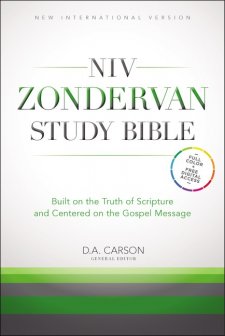
NIV Zondervan Study Bible - A Review


NIV Zondervan
Study Bible
NIV Zondervan Study Bible.jpg
Edited By
D. A. Carson

A Review

Some 40 years ago I sat under the teaching of D. A. Carson for Greek Exegesis.  It was my third or fourth semester of seminary at Trinity Evangelical Divinity School. Worse than that, it was Dr. Carson’s first seminary class at Trinity.  Though I had done okay in my first two semesters of Greek, I felt over my head under his tutelage.  

So  now, 40 years later, I have the opportunity to get revenge. But having spent a couple of weeks with his newly released Study Bible - I have no intention of doing so. The word that came to mind as I opened the package containing my review copy was, “Massive.”  And I have not been able to shake that initial feeling.  At nearly 4000 pages, this book is more than a Study Bible.  It is truly a single volume Bible Commentary, a set of theological essays, and a rather well-done, though compressed, concordance.  

Articles are written by a variety of scholars from the Reformed or Baptist heritage - with an obvious lack of representation from Wesleyan/Holiness  schools or churches. Not surprising given that Zondervan is the publisher, but disappointing, none-the-less, for a work of this size.  

This reader enjoyed the formatting of the book. Notes are clearly set aside from the Biblical text by giving them a light green background, while the Biblical text has a more standard white background.  The use of full-color pictures  throughout adds value to the work.  A number of tables summarize important topics - the tables also make use of tables to help important columns or rows stand out.  As with most Study Bibles, the appendix includes a good supply of Bible maps; unlike some, the body of the book also includes a large number of colored maps which supplement the notes. The hard copy also includes access to an electronic copy of the book.  

I have a few favorite Study Bibles - the NIV Zondervan Study Bible will/has become another of those favorites.  I will be consulting it often - I suspect others will as well.
______________

This review is based on a free copy provided by the publisher for the purpose of creating this review.  The opinions expressed are my own.