Monday, November 28, 2016

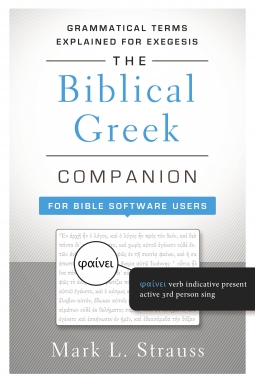
The Biblical Greek Companion - A Review


Biblical Greek Companion.jpg


A Review

It was a year ago that I reviewed the companion volume, Biblical Hebrew Companion. I ended that review expressing hope that a similar book would be forthcoming for Biblical Greek. Now it has.   

Similar to the earlier volume, this 100+ page reference book serves as a simple desk dictionary/encyclopedia on Biblical Greek Syntax and Morphology.  It is not designed to teach Greek, other books do that well; but to assist the user in understanding how the various syntactical and morphological issues can be used to better understand the Greek used in the New Testament. The author, in his introduction, does a good job of summarizing the audience to which this work is best addressed:

  1. Pastors and other ministry leaders who may have learned biblical Greek at one time, but have experienced the loss of much of that learning because of the time demands of life and ministry;
  2. College and seminary students who are engaged in a biblical Greek language course, but who could use this resource as a supplement to provide easily accessible and simplified explanations, along with clear biblical examples;
  3. College and seminary students who are enrolled in an academic program that no longer requires them to learn the biblical languages, but who wish to have access to the wealth of available resources for original-language study;
  4. Those who have never had the opportunity, resources, or inclination to learn the paradigms, vocabulary, grammar, and syntax of biblical Greek, but would still like to benefit from the deeper insights into the Bible that Greek study can provide

As with the earlier work, I wish I had it by my side while learning Greek - as it takes each major part of speech, each verbal conjunction, each grammatical construction and gives insight to the reader on its role in the language. The entries try to address three questions:

  1. What does it look like?
  2. What does it do?
  3. How it might effect the exegesis of a passage?

A number of appendices add value as they bring together lists of topics that don’t fit elsewhere: The Greek Alphabet, Punctuation, ect. Also included are a scripture index and a suggested bibliography for further study grouped by topic.
______________

This review is based on a free electronic copy provided by the publisher for the purpose of creating this review.  The opinions expressed are my own.

Rick Warren's The Lord's Prayer - A Review


The Lord’s Prayer

Warren The Lords Prayer.jpg

by
Author: Rick Warren
Illustrator: Richard Jesse Watson

A Review

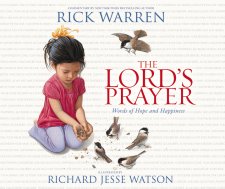
It was probably not the first prayer I ever learned, but it was one of the first that I memorized. Rick Warren has written a nice and simple commentary on this most famous of prayers uttered by Jesus. Each entry is composed of four parts:

  1. A line (or phrase) from the Lord’s prayer
  2. An illustration working off the theme found in the quoted phrase
  3. A four (or so) line commentary responding to the quoted phrase
  4. A simple prayer echoing the phrase and commentary

The illustrations are colorful and gripping. They will hold a child’s (and maybe the parent’s) attention.  The commentary is not particularly deep; but because the book is written for a the 4-8 year old child, I would not expect an in depth exploration of the Lord’s Prayer. However, I expect both the parent and the child would find the entire presentation to an encouraging addition to their spiritual walk - regardless of their physical or spiritual age.

This book belongs in the preschool section of the church library and in the homes of preschoolers and beginning readers. It would make a great Christmas or birthday gift - I would say a stocking stuffer, except the 12”x18” size means it will not fit into most stockings.
______________

This review is based on a free copy provided by the publisher for the purpose of creating this review.  The opinions expressed are my own.
Wednesday, November 16, 2016

The Whole Art of Detection - A Review


The Whole Art of Detection.jpg


A Review

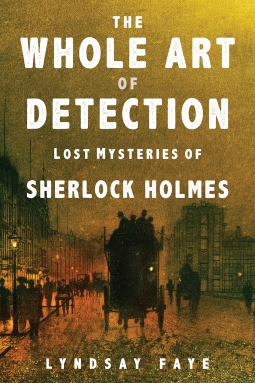
Though I like the legend of Sherlock Holmes, I am not a Sherlockian. If I like a Sherlock Holmes story, it is because I like it; not that it fit well within the Holmes canon as defined by those with a more scholarly bent. Having said that, I found The Whole Art of Detection to be a pleasant trip through Holmes’ life events. The book is a selection of short stories that span much of Dr. Watson’s interaction with Holmes. They are written from a variety of perspectives - most are a retelling of adventures had by Dr. Watson and Holmes, but the book also includes a few 1st person excerpts from Holmes’ personal diary.

The fifteen stories are a bit uneven - some are quite capable of holding the reader’s interest, while other seem a bit longer than necessary. The stories introduce details of Holmes’ and Watson’s life - including the reaction of friends to Watson’s wife’s, Mary, death. Similarly, we see a glimpse of Watson’s response to learning that Sherlock Holmes had returned to Baker Street from his supposed death in Switzerland.

I kept coming back each night to find out what was next in the life of our two friends. In the course of reading, of course, we again meet Mrs. Hudson and Inspector Lestrade. We travel throughout London and its environs.

For the fans of late 19th century London and Sherlock Holmes, this book might just fill the bill for a late night read. It did for me, it will others as well.
______________

This review is based on a free electronic copy provided by the publisher for the purpose of creating this review.  The opinions expressed are my own.
Tuesday, November 15, 2016

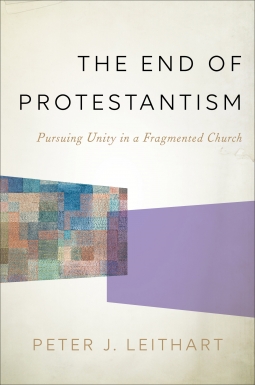
The End of Protestantism - A Review


End of Protestantism.jpg


A Review

The Protestant Church at the beginning of the 21st century is a broken and fragmented church; often more defined by what we are not, than by what we are. Dr. Leithart argues that our goal is to become one church as Christ prayed, “... that they may be one, just as you, Father, are in me, and I in you …” The flaw with this desire is that it is a heavenly goal, one that we expect to see at the end of time, not one we will see completed by broken people living in broken relationships. Ideal, yes; but not one likely to be seen this side of eternity.

In some ways, the author argues that the church was closer to this ideal at its beginning. As the church grew geographically, the ties to its early apostolic roots began to disintegrate. Five-hundred years later Martin Luther nailed his 95 thesis to a church door, creating more division. Calvin, Zwingli, and the other reformers added to the  splintering of the church - even though their goal, as their name implies, desired to reform the church. As governments began to support one splinter group after another, the splits became more ingrained into culture and a future unit more difficult to envision.

When the church crossed the Atlantic and made its presence known in the new world, the divide grew. Different divisions claimed different territories - the roles of the Dutch Reformed, the Anglicans, the Catholics, etc., in their various colonies cemented their differences. But as the colonies had to work together to form a new country, so the churches had to learn to cooperate. The result was a grudging acceptance, but not real unity. We have gotten to the point, as I mentioned in my introduction, where we define ourselves by what we are not, rather than by what we are.

But we cannot stay where we are - we need to move toward a unity much as the Father has with the Son.  

The biggest problem I have with Leithart’s goal is that he neglects to take into account that we are working with broken people in broken churches. I expect that a 21st century unity will recognize our differences and that those differences will give each local church strength and weaknesses. Much as the various spiritual gifts come together in a local body, the various strength and weaknesses of a community of local churches must come together to build the Kingdom of God.  Rather than using our differences to divide us, let us use our difference to build the Kingdom, one stone at a time.
______________

This review is based on a free electronic copy provided by the publisher for the purpose of creating this review.  The opinions expressed are my own.
Thursday, November 10, 2016

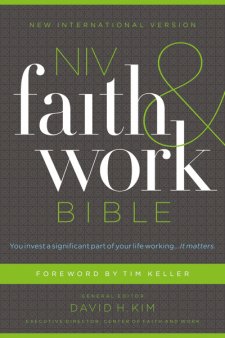
NIV Faith and Work Bible


Faith & Work Bible .jpg


A Review

My interest in this Bible comes via a number of avenues. First, my thoughts return to my training as a vocational counselor.  Much of that training focused on the value we as humans place on work and/or being out of work. I was also drawn to this Bible by my work with college students completing their internships in Computer Science.  But my interest came most clearly as I thought of my own somewhat staggered career path - which has included formal education and experience in Chemistry, Ministry, Computer Science, and Counseling. As the book’s cover suggests, “You invest a significant part of your life working … it matters.”

This Bible consists of helps that focus on work and the study of Scripture and the Christian life in general. These include a series of biographical and anecdotal stories of those who involved with their work and a series of essays written by well-known Christians exploring the topic of work and faith. Of a more general nature are a series of brief articles dealing with core doctrines that will influence our attitude toward our life’s work and a 31-day reading plan for studying “Scripture’s overarching storyline.”  Helpful indexes are provided to the biographical, doctrinal, and storyline studies.

The variety of helps means this reader is unsure whether this volume is better classified as a Study Bible or as a Devotional Bible - perhaps it is some unknown type of Bible that lies somewhere in between. It  is also unclear to whom this Bible is addressed. It would be a welcome addition to the library of the Christian involved in vocational counseling (whether a professional counselor or a pastor). It also belongs in the church library within reach of the lay community seeking their own understanding of their career  choices. Finally, this Bible would be a welcome gift for the layperson examining their own career decisions - either at the beginning of their career or seeking a mid-career change.  
______________

This review is based on a free copy provided by the publisher for the purpose of creating this review.  The opinions expressed are my own.
Monday, November 7, 2016

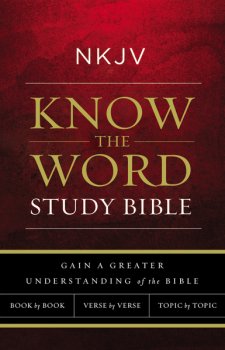
NKJV Know the Word Study Bible - A Review


NKJV Know The Word Study Bible.jpg


A Review

This book represents a Study Bible that does not seem to know what it wants to communicate. Providing three tracks for study (Book by Book, Verse by Verse, and Topic by Topic), it never seems to really accomplish any of these with any sort of consistent vision. Tools are provided for each track, but none of them provide the depth this review would expect from a really good Study Bible. I would have preferred to have the editors pursue one of these tracks with more depth and consistency.  

Let me use the Topic-by-Topic track as an example. The Bible tackles 21 different topics (only 21? - for a true Study Bible, this seems weak) providing five notes on each topic. There are three exceptions. The discussion on “God the Son” provides seven notes, the discussions on “Sanctification” and “God’s Will” each provide six notes each. The notes are laid out in such a way that the reader can follow the “trail” forward to the next note, but without any reference to the previous note or the beginning of the thread, he or she is forced to refer to the index in order to follow the topic from beginning to end. Each note provides a look at one verse dealing with the topic, allowing the reader little room to more deeply explore the given topic. Cross references are either from the translators of the NKJV or from the verse by verse study notes - nothing specifically designed to help with further topical studies.  

Sadly, the indexing is minimal. The topic index, mentioned earlier, is designed to point the reader to the five, six, or seven, notes on each of the 21 topics. There are no indexes focusing on the Book by Book studies or the Verse by Verse studies. The appendices consist of tables of “Monies, Weights, and Measures,” a typical Bible Concordance, and a typical set of Bible Maps. None of these appear to be designed specifically to augment this Study Bible.

This Bible would serve as a great gift for a new believer, or for the high school graduate beginning their own study of scripture. The notes that are provided, are useful, but not sufficient for deeper study. Thus, this Bible would be of lesser value to the seminary student or pastor with access to other tools, Bibles, and resources, to supplement his or her study.
______________

This review is based on a free copy provided by the publisher for the purpose of creating this review.  The opinions expressed are my own.
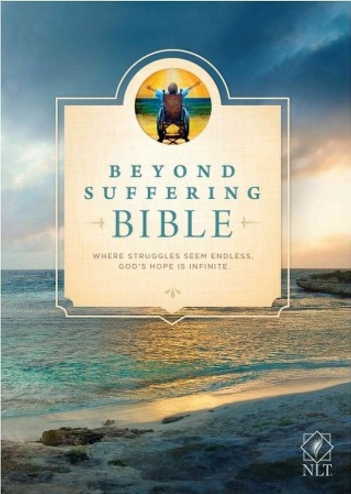
Beyond Suffering Bible - A Review


Beyond Suffering Bible.jpg


A Review

Though being marketed as a Study Bible, I think this Bible is has more similarities to today’s Devotional Bibles. Having said that, this Bible is the best Devotional Bible I have seen in a long time (ever?). It belongs in the hands of every pastor, caregiver, personal sufferer - anybody that finds themselves in a hopeless situation. As the reader might guess, that includes most of us.  

A variety of helps contribute to the value of this Bible. Devotionals are scattered throughout the Bible, many of them written by Joni Eareckson Tada, focusing on the many sides of suffering. Along with the devotionals, are a series of character profiles and application guides (“Connection Points”).  Also included are a set of ten weekly reading plans :

  1. Comforting Those Who Mourn
  2. Disability and the Image of God
  3. Growing Spiritually Through Suffering
  4. Intellectual Disability and Salvation
  5. Healing: A Proper View
  6. The Role of the Church
                  in Suffering and Disability
  7. Praising God Through Suffering
  8. Suffering and Spiritual Formation
  9. What Causes Disability
  10. Victory Through Weakness

Along with these resources, found in the text itself, there are also a series of essays from a variety of authors addressing the issue of suffering and the believer. I appreciate that the publisher has not left this book standing by itself. Near the end of the book is a two-page list of additional recommended resources: Books, Curriculum Resources, Joni and Friends Websites, and Other Helpful Websites. A very useful, comprehensive topical index is provide to give access to the various materials.

Though more like a Devotional Bible, the reader will find the typical helps (though nothing special) found in a Study Bible: Cross References, Dictionary and Concordance (combined), and Bible Maps. Finally, I should note that the contributing authors are listed, for both those who worked on the NLT translation and on the Beyond Suffering Bible.

As I hinted earlier, some version of this Bible belongs in the hands of every Pastor, lay leader, Sunday School teacher, church library, and family. We each will need to deal with suffering someday, somewhere. This Bible can help prepare us for that task.
______________

This review is based on a free copy provided by the publisher for the purpose of creating this review.  The opinions expressed are my own.