A Review
I was hesitant to agree to review this book. I clearly do not put myself in the reformed church tradition - yet, as a Wesleyan pastor, theology does intrigue me, and I want to understand it as best I can. I was not disappointed.
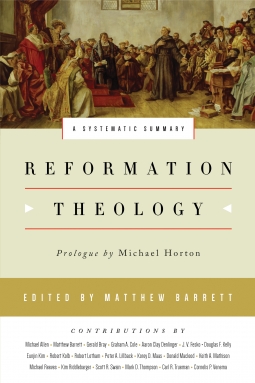
In spite of the title, the book is not a theology text, per se. It fits most closely under subject heading “historical theology”, but it does not quite fit there either. When I consider the topic of “historical theology” I expect to find the book or paper to follow the development of a theological theme over time - from the original scriptures and early church, to the church fathers, through the middle ages and the reformation, to its current understanding in the church. This book does not do that. Rather, this book takes a snapshot of the broad areas of theological study (from the doctrine of scripture to eschatology) as they were understood during the formative years of the reformation. Written as a series of essay, each dealing with a specific theological topic, the various authors attempt to examine the doctrinal issues through the eyes of major players in the reformation. As an example, let me draw from the “Abstract” on the essay entitled “Sola Scriptura” by Mark D. Thompson:
ABSTRACT
Sola Scriptura is sometimes described as the formal principle of the
Reformation. Certainly, an appeal to Scripture’s final authority is
a common thread throughout the writings of the major theological
voices of the Reformation, despite their distinctive emphases and
particular interests. This chapter examines the thought of Luther,
Melanchthon, Zwingli, Bullinger, Calvin, and Cranmer on the au-
thority of Scripture in an attempt to highlight both their common
perspective and their unique contributions. It also argues that de-
spite the genuinely revolutionary character of the Reformers’ ap-
peal to Scripture, it in fact relied on antecedently held convictions
about the nature of Scripture and its right to determine Christian
faith and practice.
The reader will notice that the author attempts to draw from the thoughts of Luther, Melanchthon, Zwingly, Bullinger, Calvin, and Cranmer. Other writers may draw from a subset of these individuals or extend their writing to include elements of the Counter-Reformation and other contemporaneous groups. Interestingly, Wesley’s name is mentioned only once, in the Prologue, which sort of serves as later limit of the book’s coverage.
I found the reading to be a bit uneven - the Prologue was very difficult, formal, scholarly; some essays followed the same pattern, while others were more readable by the typical seminary and graduate student. They were still scholarly and well-researched, but not so formal as to hinder the reader’s understanding. The book was not written as a defense of Reformed theology, but as an explanation of the reformers' theology at the time they lived. Some authors simply echoed the reformers' ideas, others tried to place those ideas into their cultural settings. Speaking of authors, the only name familiar to this Wesleyan reviewer was that of Michael Horton (who wrote the Prologue) - I expect that this is more a result of this reader’s background than the quality of the scholars chosen to be part of the project.
Though the Advanced Readers Copy did not include indexes, a Name Index, a Subject Index, and a Scripture Index are scheduled for inclusion in the final edition of the book. These will add significant value to the book.the
This book does belong on the shelf of all scholars coming out the reformed church or having an interest in historical theology. Having said that, I would recommend the book be read by Christian scholars of all stripes - whether a personal copy or one borrowed from the library. Luther, Melanchthon, Zwingly, Bullinger, Calvin, and Cranmer, each contributed to the protestant reformation in their own way. Understanding that contribution will be important to all of us.
______________
This review is based on a free electronic copy provided by the publisher for the purpose of creating this review. The opinions expressed are my own.