Showing posts with label Philosophy. Show all posts
Tuesday, March 19, 2019
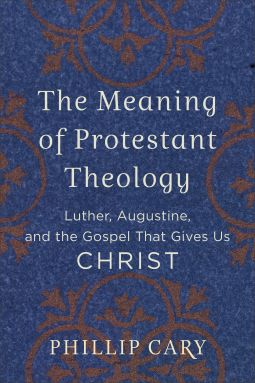
The Meaning of Protestantism - A Review
My first thought as I began to read the opening pages of Phillip Cary’s book “The Meaning of Protestant Theology” was that I had picked up a boring, poorly written book that would be difficult to recommend for an average reader.
That was my impression of the introduction - I thought I was looking at a book written for the very intelligent, scholarly reader, a class into which I do not place myself. I read all the introduction and my opinion did not change. It did not seem fair, however, to judge a book solely by its introduction, so I began chapter 1. I found a readable, interesting essay discussing the work of Plato as assimilated by early Christian writers. This sets the foundation for the book which is designed to follow the thoughts of Plato to Augustine to Luther and the Reformation.
The book is readable and interesting, unlike the introduction. The book will be of interest to those interested in the development of Protestant (Lutheran) theology through history - though the writer clearly states that he has no desire of leaving the reader a devotee of Luther’s teaching; the author clearly states that he is Episcopalian. Not a systematic theology, but clearly rooted in the discipline of historical theology.
Though not knowledgeable in this field, I found the book interesting and relatively easy to read as, to me, an introduction to historical theology. The book probably would not find a home in most local church libraries, though individual pastors with an interest in pre-Christian philosophy, early Christian theology, and the development of early Protestant thought may find it of interest. Most seminaries, both Protestant and Catholic, would find a place for this book in their collections as it begins by exploring the connection between Platonism and Augustine and ends by exploring the connection between Plato, Augustine, and Luther.
______________
This review is based on a free electronic copy provided by the publisher for the purpose of creating this review. The opinions expressed are my own.
Tuesday, October 17, 2017
Evidence That Demands A Verdict - A Review
A Review
Let me begin with a bit of truth in advertising. I was an invited member of the original Launch Team for the newest version of “Evidence That Demands A Verdict”. In return for being a part of the Launch Team, I received an e-book version of ‘Evidence” and a tee-shirt promoting the book. However, the e-book was flawed. By design, the pre-publication version that we were sent included a large watermark in the middle of each page, making it very difficult to read (at least for this reader). In spite of being a part of the Launch Team, I decided it would be unfair to review a book I could not fairly read. Two months later I found (using my normal review book resources) an opportunity to receive and review a hard copy of the book. This review is based on both the original “Launch Team” version which I received last June and the hard copy I received earlier this month.
-----------------------------
I remember receiving the original version of “Evidence” as a junior or senior in college. I devoured it. As a new believer, I wanted to know and understand as much as possible about this faith to which I belonged. Later, after graduating from seminary, I discovered a new version and purchased it. I remember trying to become as excited about it as I had the original - it was not to be. I do not if it was further education, my personal faith journey (which took an unneeded bounce during those years), the fact that I had changed the immediate direction of my career (from pastoral ministry to Computer Science college professor), or the book itself which caused the loss of interest; but I had lost interest.
The year is now 2017 and the third (or is fourth?) edition of this classic book is being published. The newest version is not one I would not want to sit down and devour (though I know there are some readers who have done that), but I would not want to miss having the newest edition on my shelf. Rather being aimed for the newly converted college student, this new book is aimed for the college or seminary classroom or for the desk and shelf of the pastor or scholar. For many, not sitting in a classroom, it will become a reference book, rather than late night reading. But it is a reference book that many (or most) believers will want on their shelves.
At just under 800 pages, the book addressed most of the issues attacked by modern critics of the Christian faith. Whether it be philosophy, religions, history, or science (plus more) the reader will be challenged to examine evidence for the Christian faith. Whether a believer, skeptic, or atheist, the critical reader will need to respond to the author’s arguments. The book is thoroughly referenced with in-text notes and a Bibliography providing complete details of each resource quoted or used in the book. The only missing element, for most students of the scripture, is a set of sources allowing followup to the many topics discussed in the book. It will become the responsibility of the pastor, the teacher, or the individual reader to provide access to additional resources on topics of interest. It is this missing element that prevents this reviewer from giving the book a 5-star review.
The book is not general reading - it is aimed at the scholar. Few (are there any?) diagrams can be found within the covers, though charts are present as needed which will help the reader to process the evidence presented.
_____________
This review is based on free paper and electronic copies provided by the publisher for the purpose of creating this review. The opinions are mine alone.
Labels:
Apologetics,
Archaeology,
Christian,
history,
Philosophy,
Reference,
Science,
Theology,
well-researched
Tuesday, January 5, 2016
Divine Science - A Review
A
Review
Rarely, if ever, have I run across an author that accepts scripture
and science at face value, as equal partners in discovering truth. The author
has no problem in stating that he sees himself as a “cradle Catholic”; more
importantly, at least to this reader, his faith in the Grace of God is his own.
At the same time, the author makes it clear that as a tenured member of the
University of California-Irvine Department of Physics, he is a scientist. He takes his faith seriously; he takes
science seriously.
Too often, these kind of statements are made so that the
speaker can join the discussion, though the statements are made lightly. But as
the reader makes his way through this book, it becomes clear that Dr. Dennin
attempts to make both of these foci key parts of his decision making. Though I
do not agree with all of his conclusions, I do appreciate his attempts to weave
his faith together with his science to make a single coherent world view.
Something most writers find hard to do.
Using a combination of Scripture, Theology, Philosophy, and
Science, the author seeks to discover the “fullness of reality” as God intended
it to be seen – giving a fuller view than would be possible if we relied on one
or the other alone.
I do appreciate the work that Michael Deninn is attempting to
do. I remember the job interview I had at a Midwest Christian College. I was
told up front that I would be fired if I in any way supported creation (note, my
field was Computer Science). The author does not support a seven-day creation
approach, but, at the same time, he has no problem acknowledging God’s presence
and work in the creation event. Early in the book, he quotes an undergraduate
faculty member addressing the Creation story:
That story may be factually false,
but it is a myth. And a myth can convey truths that are more important, more
salient, and more applicable than any fact that you might encounter. That story
is better than factual, it is truthful.
The author accepts scripture at face value, recognizing that
it represents different authors, with differing backgrounds, and written using
different genres. Each of these truths serves as the foundation for good
exegesis – and means that he takes not only his faith seriously, but also the
scriptures.
The reader may not accept all of the conclusions that come
from the author (as I said earlier, this reader does not), but the author and
this book do deserve a careful reading by both the theologian and the believing
scientist.
______________
In the
interest of openness, I should point out that this review is written by an
ordained Protestant pastor who spent 24 years in the college classroom teaching
Computer Science. The review is based on
a free electronic copy of this book provided by the publisher for the purpose
of creating this review. The opinions
expressed are mine alone.
Subscribe to:
Posts (Atom)


