Showing posts with label History of Science. Show all posts

Thursday, March 18, 2021

Einstein's Fridge - A Review


Einstein's Fridge


;]
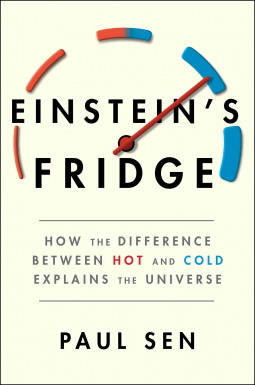

by

Paul Sen


A Review


Paul Sen has created a fascinating book discussing the history of physics from the mid-19th century to the present as he takes the reader on a journey through the development of the field of thermodynamics.


During our journey we meet men and women who shaped this new field of study. Some of those we meet are well-known (e.g. James Watt), some are well-known for their contributions in other fields (e.g. Alan Turing), and some are more obscure (e.g. Emmy Noether). Regardless of their reputation, each contributed significantly to the body of knowledge we now know as thermodynamics.

Focusing on the people, the book is not a mathematical monograph, but uses a series of thought experiments to help his readers understand the growth of this subfield of physics. It was interesting how new ideas grew upon each other and, occasionally, folded back on an earlier researcher to again further the world’s understanding of the relationship between heat and cold. The book will be appreciated by anyone with a basic high school or college freshman physics course under their belt.

Two notes found in the Epilogue of the book help the reader understand the author's intention of writing this work:


At its heart, this book is a celebration that between 1850 and today the science of heat has played a vital role in promoting the greatest improvement in the human condition in our species’ entire history. 

-----------------------------------

The main obstacle to dealing with climate change isn’t scientific. Instead, it’s political and emotional. While some refuse to accept that the problem exists, others refuse to accept the solutions. That brings me back to why I wanted to write this book. Now, more than ever, it’s important that all of us have a basic grasp of the science of heat, so that we can make sensible and informed decisions about how best to ensure progress while preserving or improving living conditions fo fellow humans without ruining the environment. Should we commit to nuclear energy? Should we drive electric cars? How much tax should we pay on petrol, and how much should we subsidize wind farms? We will be in no position to answer these vitally important questions unless we have a basic understanding of the laws of thermodynamics.

Weaving together Carnot’s basic understanding of heat, Turing's application of information theory and embryology, and Einstein’s Theory of General Relativity, as well as the work of many others, I give the book five stars.
_____________
This review is based on a free electronic copy provided by the publisher for the purpose of creating this review. The opinions are mine alone.

Tuesday, December 1, 2020

The Light Ages - A Review


The Light Ages

by

Seb Falk


The author makes clear that the Middle Ages or Dark Ages were not nearly as devoid of scientific thinking as common knowledge would have us think. Each chapter tackles two or three threads of science. This is done by exploring the life of a typical (though highly educated) monk living at St. Albans Abby, north of London.

The only problem is that some chapters cover too much material. For example, the first chapter explores the making of the modern calendar and astronomy’s influence on agriculture of the era. The second chapter approaches the development of timekeeping and its influence on agriculture. I found the discussion of the understanding of 24 equal hours of the day from the earlier practice of dividing the time between sunrise and sunset into twelve hours, and the time between sunset and sunrise into twelve hours. The early practice meant twelve shorter daylight hours during the winter season and twelve longer daylight hours during the summer season. Because the church played such a major role in the life of the Middle Ages, it was important to understand the church’s role in promoting new scientific knowledge and in hindering its growth at times.

I found the book interesting, but it sometimes felt as if the author was blending too many topics in each chapter. As this reader progressed through the book, it became obvious that seven chapters of the book could naturally be presented in smaller units. This might make the book more accessible to the casual reader. This reader would give the book four out of five stars.
______________
This review is based on a free electronic copy provided by the publisher for the purpose of creating this review. The opinions expressed are my own.


Friday, June 15, 2018

The Story of Computing - A Review


The Story of Computing


by
Dermot Turing


A Review


Alan Turing’s nephew has compiled a history of computing. The book is an interesting read for this reader who lived through much of it beginning in 1968. Lots of trivia bring the story alive.

Two flaws make the book less than perfect. First, the book reads as it were a compilation of magazine or journal articles compiled into a book, rather than a book written as a complete whole. This is most notable when the reader finds the same individuals reintroduced as if they were new characters in different parts of the book. One gets the impression that the author has forgotten that he had previously introduced the character in a previous context.

The other flaw is the occasional historical gaffe introduced by the author. For example, while discussing the problem of calculating taxes during the time of Caesar Augustus, the author says, “and as our informant is St Luke, who was a tax man, we can assume he is reliable.” But as most students of scripture know, St Luke was not a tax man, but a physician. St. Matthew was the tax collector. A small error, but it makes this reader question the other bits of trivia throughout the book. The scholar who may choose to use this book as a source would be wise to verify any details borrowed from the book.

The book does provide details that this reader has not seen elsewhere – making it an interesting read. It would be a valuable addition to the library of anybody interest in computer history. It also has the potential for serving as an ancillary text for the computer science service course or in the first course as part of a computer science degree.
______________
This review is based on a free electronic copy provided by the publisher for the purpose of creating this review. The opinions expressed are my own.


Tuesday, December 12, 2017

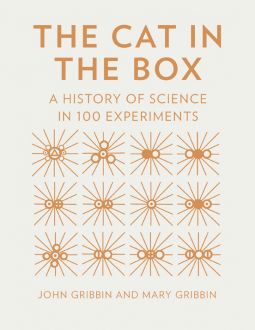
The Cat in the Box - A Review


A Review


Originally published in the UK in 2016, The Cat in the Box has now made its way to the USA with a 2017 publication date. The book is a fun history of science, focused, not on the people of science or the discoveries, but on how the scientific method and the experiments that used this method moved the various disciplines forward.

The author begins by giving a simple definition of the scientific method:

science is nothing without experiments. As the Nobel Prize-winning physicist Richard Feynman said, “In general, we look for a new law by the following process: First we guess it; then we compute the consequences of the guess to see 
what would be implied if this law that we guessed is right; then we compare the result of the computation to nature, with experiment or experience [observation of the world], compare it directly with observation, to see if it works. If it disagrees with experiment, it is wrong. In that simple statement is the key to science. It does not make any difference how beautiful your guess is, it does not make any difference how smart you are, who made the guess, or what his name is—if it disagrees with experiment, it is wrong .” [Richard Feynman, The Key to Science, Lecture at Cornell University, 1964 (www.youtube.com/watch?v=b240PGCMwV0)] 

Those words—if it disagrees with experiment, it is wrong—provide the simplest summary of what science is all about.

Beginning with that definition, we begin to look at the various ways the physical and biological sciences have used the scientific method to reach the current state of knowledge.

The first experiment discussed is from the 3rd century BCE with Archimedes discovery that equal volumes displace equal volumes of water. Tradition tells us he made the initial hypothesis by watching the water displaced as he sat into his own bath - followed by experiments that proved the hypothesis correct.

The most recent rendition of the book includes a 101st experiment, carried out in 2015 and published in 2016, establishing the gravitational waves spreading out through the universe.

Between those two events, we meet a variety of men and women who made significant contributions to science through their experiments. The author also does a careful job of showing how on scientist discovery provided the foundations for the next generation’s hypotheses. Included are many references to the original publication sources where the experiments are described. Though the 101 experiments are presented in chronological order, in-text notes point to earlier and later work that connect to the current story. As the author concludes,

This astonishing experimental result [the proof of gravitational waves] was the culmination of more than two thousand years of experimental science. And it all began with another kind of wave—ripples in the bathtub of a Greek philosopher called Archimedes. 

The book, though not based on mathematics, is written for a high school graduate or college student. The text is not hard reading - experiments are well explained. The book would have a place in a lower division general science course or an upper division or graduate level history of science course. Though not every experiment could be safely duplicated in the context of a college semester, many of them could be chosen for demonstration or as student projects (perhaps with some simple modification).  
______________
This review is based on a free electronic copy provided by the publisher for the purpose of creating this review. The opinions are mine alone.