Showing posts with label computers. Show all posts

Thursday, December 12, 2019

Online Search - A Review


Online Search 


byEmma Huddleston


The title, Online Search, is a bit of a misnomer. Searching is only one of the topics covered in this 50-page book. A better title might be “A Child’s Introduction to Computers”. The book, whose reading level is for the upper elementary or middle school student, includes such topics as computer history, computer technology, and the role of programming in the development of computer technology (it does not teach programming, per se). The topics covered are similar to those seen in a college freshman computer science course from the late 20th century to the beginning of the 21st century. The book includes a great many pictures and photographs illustrating the topics discussed.

The book would make an excellent Christmas or birthday gift for the inquisitive child. It would be a welcome addition to the elementary school or public library. I expect even some parents would find the content of interest.

______________
This review is based on a free electronic copy provided by the publisher for the purpose of creating this review. The opinions expressed are my own.



Friday, June 15, 2018

The Story of Computing - A Review


The Story of Computing


by
Dermot Turing


A Review


Alan Turing’s nephew has compiled a history of computing. The book is an interesting read for this reader who lived through much of it beginning in 1968. Lots of trivia bring the story alive.

Two flaws make the book less than perfect. First, the book reads as it were a compilation of magazine or journal articles compiled into a book, rather than a book written as a complete whole. This is most notable when the reader finds the same individuals reintroduced as if they were new characters in different parts of the book. One gets the impression that the author has forgotten that he had previously introduced the character in a previous context.

The other flaw is the occasional historical gaffe introduced by the author. For example, while discussing the problem of calculating taxes during the time of Caesar Augustus, the author says, “and as our informant is St Luke, who was a tax man, we can assume he is reliable.” But as most students of scripture know, St Luke was not a tax man, but a physician. St. Matthew was the tax collector. A small error, but it makes this reader question the other bits of trivia throughout the book. The scholar who may choose to use this book as a source would be wise to verify any details borrowed from the book.

The book does provide details that this reader has not seen elsewhere – making it an interesting read. It would be a valuable addition to the library of anybody interest in computer history. It also has the potential for serving as an ancillary text for the computer science service course or in the first course as part of a computer science degree.
______________
This review is based on a free electronic copy provided by the publisher for the purpose of creating this review. The opinions expressed are my own.


Monday, October 6, 2014

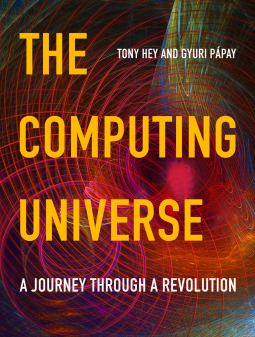
The Computing Universe - A Review


A Review


I began my computing journey early by most standards - in 1966 as part of an explorer post sponsored by IBM in Sacramento, CA.  We spent time learning COBOL (which made little sense to me at the time) and FORTRAN (a good match for beginning interests in the sciences).  I had no idea how early in the history of computers my experience came - I grew up with computers, at least as portrayed in Sci-Fi from the late fifties and early sixties.  


Later, my formal education would allow me to program in FORTRAN and Assembly Language.  Other environments presented themselves as I completed a Masters degree in Computer Science Education at the University of Evansville.  Eventually, I spent nearly 24 years teaching computers at the postsecondary level in both public and private institutions. I enjoyed that career.


This book, The Computing Universe, allowed me to re-walk through much of that career - its history and its accomplishments.  The book begins with history and jumps into the details that define the field of Computer Science as defined by its science and art.  I remember one question on a final exam for a course that I took as part of my Masters degree asked, “Is Computer Science an ‘art’ or a ‘science’.  My reply to the question was neither, it is a craft.  Many people can put together a computer program, but it takes a well-trained practitioner, a craftsman,  to create a really good program.  The Computing Universe convinces me that I was correct then - and it is still true today.


The authors claimed to  have aimed the book at the high school senior or college freshman, though I expect that parts would be more readable off the shelf to a college graduate.  The chapter entitled “Mr. Turing’s amazing machines” (sic) begins by saying “WARNING: This chapter is more mathematical in character than the rest of the book. It may therefore be hard going for some readers, and they are strongly advised either to skip or skim through this chapter and proceed to the next chapter. This chapter describes the theoretical basis for much of formal computer science.”  I would suggest similar warnings be attached to other chapters as well (e.g. the chapter on “Algorithmics”).  Having said that, I would think that the book might be readable by anyone with a college education or the high school preparation for a college education.  Though not written as a textbook, the book could serve as the text for a entry level Computer Science course designed for non-majors (given appropriate lecture support) or as an ancillary text in the first course of a Computer Science major.


I enjoyed the review of my last fifty years - from high school to retirement.  I would invite anyone with an interest in Computer Science and its foundations (both historical or theoretical) to join me in reading The Computing Universe.  
_____________

This review is based on a free electronic copy provided by the publisher for the purpose of creating this review.  The opinions expressed are my own.