Showing posts with label Physics. Show all posts

Thursday, March 18, 2021

Einstein's Fridge - A Review


Einstein's Fridge


;]
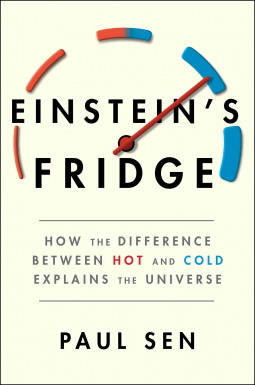

by

Paul Sen


A Review


Paul Sen has created a fascinating book discussing the history of physics from the mid-19th century to the present as he takes the reader on a journey through the development of the field of thermodynamics.


During our journey we meet men and women who shaped this new field of study. Some of those we meet are well-known (e.g. James Watt), some are well-known for their contributions in other fields (e.g. Alan Turing), and some are more obscure (e.g. Emmy Noether). Regardless of their reputation, each contributed significantly to the body of knowledge we now know as thermodynamics.

Focusing on the people, the book is not a mathematical monograph, but uses a series of thought experiments to help his readers understand the growth of this subfield of physics. It was interesting how new ideas grew upon each other and, occasionally, folded back on an earlier researcher to again further the world’s understanding of the relationship between heat and cold. The book will be appreciated by anyone with a basic high school or college freshman physics course under their belt.

Two notes found in the Epilogue of the book help the reader understand the author's intention of writing this work:


At its heart, this book is a celebration that between 1850 and today the science of heat has played a vital role in promoting the greatest improvement in the human condition in our species’ entire history. 

-----------------------------------

The main obstacle to dealing with climate change isn’t scientific. Instead, it’s political and emotional. While some refuse to accept that the problem exists, others refuse to accept the solutions. That brings me back to why I wanted to write this book. Now, more than ever, it’s important that all of us have a basic grasp of the science of heat, so that we can make sensible and informed decisions about how best to ensure progress while preserving or improving living conditions fo fellow humans without ruining the environment. Should we commit to nuclear energy? Should we drive electric cars? How much tax should we pay on petrol, and how much should we subsidize wind farms? We will be in no position to answer these vitally important questions unless we have a basic understanding of the laws of thermodynamics.

Weaving together Carnot’s basic understanding of heat, Turing's application of information theory and embryology, and Einstein’s Theory of General Relativity, as well as the work of many others, I give the book five stars.
_____________
This review is based on a free electronic copy provided by the publisher for the purpose of creating this review. The opinions are mine alone.

Thursday, June 27, 2019

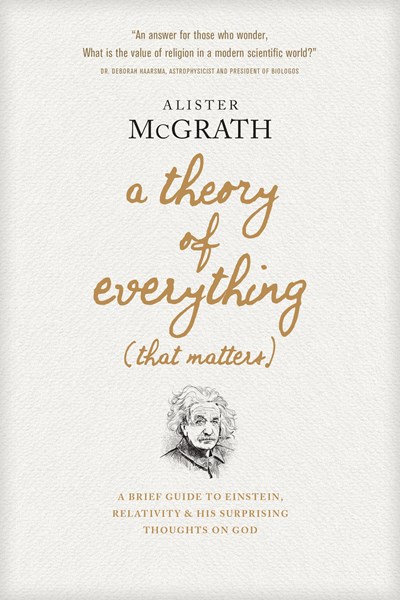
A Theory of Everything (That Matters) - A Review


I am not a physicist. But like many physicists, I barely understand Einstein and his theories if Special Relativity and General Relativity. And like most physicists, I know/knew even less about Einstein’s ideas about God. Alister McGrath has written a great introduction to Einstein’s contributions to science and his concepts of God. He also explores how Einstein’s thinking about God can help the Christian believer (Einstein was a non-observant Jew) understand the relationship of science and faith.

The first half of the book is a textual summary of Einstein’s contributions to the world of physics. The next 25% of the book introduces the reader to Einstein’s understanding of God. The book ends by asking how Einstein’s methodology - both in science and in his understanding of God - can provide a framework for the believer to understand the relationship between science and religion. The author makes clear that the reader does not need to reach Einstein’s conclusions in order to appreciate and make use of his methodology as he or she seeks to weave together the two seemingly disparate worlds of knowledge.

Well-referenced, using Einstein’s own words and those of his contemporaries, citations are frequent and helpful as they refer the reader to the author’s source material. The author uses no mathematics other than a half-dozen references to Einstein’s most famous equation, E=mc2. The Advanced Readers Copy I received contained no pictures, but throughout the book are notations that “ILLUSTRATIONS TO BE PROVIDED IN THE FINAL BOOK”. The illustrations may help with understanding the author’s points, but the text itself is easily read and understood by the non-scientist.

For the scientist, philosopher, Christian, or seeker, attempting to better understand Einstein or the interconnectedness of science and religion, this book provides essential reading. College libraries and church libraries wanting to meet the needs of a diverse set of patrons will want to add this book to their collections. My geekish and nerdish friends will want to devour this book as well.
______________

This review is based on a free electronic copy provided by the publisher for the purpose of creating this review.  The opinions expressed are my own.

Monday, October 16, 2017

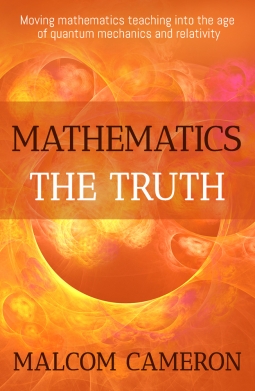
Mathematics the Truth


Mathematics the Truth

Mathematics The Truth cover.jpg

by
Malcolm Cameron

A Review
An interesting book that begins with an error on its cover makes this reader doubt the usefulness of the book. First of all, the error - the author’s name, as best I can tell, is spelled wrong. Now, this does not define the entire book, but does make one want to read it carefully.

I did find the book of interest. It is written to a beginning master’s level mathematician. It might be handled by a well-equipped calculus student with a bit of exposure to differential equations, ultimately the focus seems to be helping the student jumping into his final years of training to see the parallels between mathematics and the physical world. The author firmly that this connection to the physical world should become the real motivation for studying mathematics:

Currently mathematics is taught like Latin, without motivation, restricted to the period from Euclid in the BC to the Renaissance. Those few proceeding to university mathematics and mathematical physics are re-educated without the benefit of previous orientation while the rest are abandoned to popularisations. This is not right …

The author attempts to weave mathematics with these physical concepts that either underlay or that are supported by the mathematical truths. The book, obviously, does not a cover entire field of math or physics, but enough parallels are drawn to aid the student or teacher to take these initial thoughts further.

I do wish the book included a bit more documentation, allowing the student to continue his or own self-study of the topics presented. Too much material is presented as “common knowledge” that might be so to the fully trained mathematician, but not to the student making progress through the field. That being said, the book is readable - provided the student has a basic understanding of the mathematics. However, once the reader reaches the point where his mathematics training has progressed, a set of good math texts will be needed to fill in some of the gaps.

Physicists and mathematicians would do well to find ways to add this book to their courses as a supplementary text. Those already in the field will find the book to be of help understanding the contribution each has made to their respective fields.
______________
This review is based on a free electronic copy provided by the publisher for the purpose of creating this review. The opinions are mine alone.


Monday, December 7, 2015

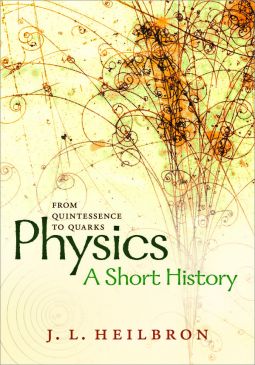
Physics: A Short History From Quintesence to Quarks - A Review


Physics A Short History.jpg


A Review


An interesting book - written for the knowledgeable reader, this history of physics assumes a great deal of prior knowledge as the moves from the study of physics as evidenced by the ancient Greeks into the early Christian Era, ending up in the modern era. The writer writes as if the reader will know the main (and some not so main) players in that history, dropping names and events that might be well-known to the physics student, but less so to the average lay reader.


This becomes less of a problem as the book moves slowly into the medieval and modern eras as names that have become famous during the development of the atomic bomb or other intriguing scientific discoveries move into the discussion.


Though interesting, these assumptions occasionally make the book difficult to follow - even for this scientifically knowledgeable reader.  The book would be a good text or ancillary text for a graduate history of science course. I would have a difficult time recommending it for the typical college graduate without having an undergraduate degree in the sciences.
______________

This review is based on a free electronic copy provided by the publisher for the purpose of creating this review.  The opinions expressed are my own.

Wednesday, June 3, 2015

Planck - A Review


A Review

An interesting tale of the time prior to World War II and its completion, Planck's life paralleled that of the famous theologian Dietrich Bonhoeffer. It was that man, and the recently revised biography by Eric Metaxes, Bonhoeffer (Abridged): Pastor, Martyr, Prophet, Spy, that partially propelled my interest in Max Planck's life. My personal interest in the sciences (evidence by degrees in chemistry and computer science) served as the other focal point of interest in Planck's life.

Though the book focuses on Planck's last years of life, his early childhood and training is discussed by means of flashbacks and recollections from the men and women that knew him before his death. In addition, the book contains a bit of physics explained in ways comprehensible to the average reader.

While, Planck son took an active role in the assassination attempt on Hitler's life (being killed himself in 1945 for his part in the attempted bombing), Planck took a milder position – seeing the cruelty unleashed on his generation, yet choosing to not stand boldly against Hitler hoping to contribute to post war Germany in spite of his age.

Max Planck, nicknamed the Father of Quantum Physics, died at the age of 90 on October 4, 1947. Though his name is well-known, his contributions to physics are not as well-known by the general-public as those of Einstein and other physicist of his time. However, without his research, there might still be holes in our knowledge of modern physics.

The book was an interesting read, fitting well with Bonhoeffer's similarly timed autobiography. It comes with a strong recommendation for anyone interested in the history of science. Though occasionally rambling, as the author moves between events current in Planck's life and those that occurred in the past, the book is enjoyable and helped this reader understand the era as it was played out in mid-20th century among the German people.
______________

This review is based on a free electronic copy provided by the publisher for the purpose of creating this review.  The opinions expressed are my own.