Showing posts with label Apologetics. Show all posts

Tuesday, October 17, 2017

Evidence That Demands A Verdict - A Review


Evidence That Demands A Verdict.cover.jpg


A Review


Let me begin with a bit of truth in advertising. I was an invited member of the original Launch Team for the newest version of “Evidence That Demands A Verdict”. In return for being a part of the Launch Team, I received an e-book version of ‘Evidence” and a tee-shirt promoting the book. However, the e-book was flawed. By design, the pre-publication version that we were sent included a large watermark in the middle of each page, making it very difficult to read (at least for this reader). In spite of being a part of the Launch Team, I decided it would be unfair to review a book I could not fairly read.  Two months later I found (using my normal review book resources) an opportunity to receive and review a hard copy of the book. This review is based on both the original “Launch Team” version which I received last June and the hard copy I received earlier this month.


-----------------------------


I remember receiving the original version of “Evidence” as a junior or senior in college. I devoured it. As a new believer, I wanted to know and understand as much as possible about this faith to which I belonged. Later, after graduating from seminary, I discovered a new version and purchased it. I remember trying to become as excited about it as I had the original - it was not to be. I do not if it was further education, my personal faith journey (which took an unneeded bounce during those years), the fact that I had changed the immediate direction of my career (from pastoral ministry to Computer Science college professor), or the book itself which caused the loss of interest; but I had lost interest.


The year is now 2017 and the third (or is fourth?) edition of this classic book is being published. The newest version is not one I would not want to sit down and devour (though I know there are some readers who have done that), but I would not want to miss having the newest edition on my shelf. Rather being aimed for the newly converted college student, this new book is aimed for the college or seminary classroom or for the desk and shelf of the pastor or scholar. For many, not sitting in a classroom, it will become a reference book, rather than late night reading. But it is a reference book that many (or most) believers will want on their shelves.


At just under 800 pages, the book addressed most of the issues attacked by modern critics of the Christian faith. Whether it be philosophy, religions, history, or science (plus more) the reader will be challenged to examine evidence for the Christian faith. Whether a believer, skeptic, or atheist, the critical reader will need to respond to the author’s arguments. The book is thoroughly referenced with in-text notes and a Bibliography providing complete details of each resource quoted or used in the book. The only missing element, for most students of the scripture, is a set of sources allowing followup to the many topics discussed in the book. It will become the responsibility of the pastor, the teacher, or the individual reader to provide access to additional resources on topics of interest.  It is this missing element that prevents this reviewer from giving the book a 5-star review.


The book is not general reading - it is aimed at the scholar. Few (are there any?) diagrams can be found within the covers, though charts are present as needed which will help the reader to process the evidence presented.
_____________
This review is based on free paper and electronic copies provided by the publisher for the purpose of creating this review. The opinions are mine alone.

Tuesday, September 5, 2017

The Apologetics Study Bible: Christian Standard Bible - A Review


Apologetics Study Bible CSB.jpg


A Review


Holman Bible Publishers has combined one of my favorite Study Bibles with what is becoming a favorite preaching Bible. The result is a tool that I will be keeping on my shelf for years to come.

Over the last few months, I have begun to appreciate the Christian Standard Bible (CSB), beginning with a couple of reviews published in February and March of 2017. It is quickly becoming my favorite pulpit Bible. I am becoming increasingly excited as Study Bibles are becoming available based around the CSB. The Apologetics Study Bible is the third such Study Bible to cross my desk.


The Bible text used in this edition is the newer Christian Standard Bible. But the changes do not stop there. Notes have been updated in this newer edition. As one example, the notes of the original HCSB Apologetics Bible for Colossians 2:8 are as follows:

2:8 The term “philosophy” occurs only here in the Bible. Paul was not making a blanket denunciation of philosophical study or even Greek philosophy (e.g., Platonism, Stoicism). Nor was he worried that the Colossians’ faith would crumble if they subjected it to critical inquiry. The article (“the”) appearing before the term in the Greek text suggests that the opponents had characterized their own teaching as a “philosophy”—the specific teaching Paul opposed.

The newer CSB version rewords this slightly and adds a bit more content:

2:8 The term “philosophy” occurs only here in the Bible. Paul was not making a blanket denunciation of philosophical study or even Greek philosophy like Platonism, Stoicism. Nor was he worried that the Colossians’ faith would crumble if they subjected it to critical inquiry. The article (“the”) appearing before the term in the Greek text suggests that the opponents had characterized their own teaching as a “philosophy”—the specific teaching Paul opposed.

“Elements of the world” (stoicheia) suggests supernatural agencies or spiritual beings.

Knowing that the text was not merely imported from the previous edition into the newer edition is a helpful observation. It means the editors were not only thinking about the Bible text, but also about the  contents of the notes.


Note - this review is specifically for the hard copy of the CSB Apologetics Study Bible. Kindle versions are flawed in that they do not provide access to the main Apologetics Study Notes - this is true for both the HCSB and CSB versions and for the separate, though related, student versions. LOGOS versions of the original HCSB Apologetics Study Bible does not have this flaw. CSB versions of both the Apologetics Study Bible and the Student versions are in the queue for possible development - given sufficient pre-orders.


Is it worth purchasing the CSB Apologetics Study Bible - only if you want the most up-to-date details and notes. I have not checked every note, so I cannot verify that there are no critical updates to the notes - the buyer may want to check important verses, chapters, or books, for changes.


______________
This review is based on a free electronic copy provided by the publisher for the purpose of creating this review. The opinions are mine alone.

Monday, July 31, 2017

CSB Apologetics Study Bible For Students - A Review


CSB-Apologetics-Study-Bible-For-Students-Cover.jpeg


A Review


Over the last few months, I have begun to appreciate the Christian Standard Bible (CSB), beginning with a couple of reviews published in February and March of 2017. It is quickly becoming my favorite pulpit Bible. I am becoming increasingly excited as Study Bibles are becoming available based around the CSB.


CSB Apologetics Study Bible For Students is the first such text to cross my path. As I approached this Study Bible, I had two questions. How does it compare to the original version of the Apologetics Study Bible and how does it compare to earlier editions of the Apologetics Study Bible For Students.  


First, how does the CSB Apologetics Study Bible For Students compare to the original Apologetics Study Bible? There are two obvious differences. The footnotes are basically the same between the original version and the student version, except that Bible references have been updated to use the CSB. I did not check every footnote in all 66 books of the Bible, but I did check those in Philippians (my current preaching text) and in the Psalms (for an example from the Old Testament). It is possible that translation decisions did not allow every footnote to use a CSB reference to support a footnoted comment.


The second difference is that sidebar material has been substantially revised from the original to the student version. In some cases this means that similar topics have merely been rewritten by a different author; in other cases, new material has been added.that will be appreciated by students (though non-students might find some of these new comments of help - e.g. the article on pornography).


The differences between the previous edition of the Apologetics Study Bible For Students and CSB Apologetics Study Bible For Students are less dramatic - mostly accounting for the change to using the CSB. As would be expected, textual footnotes are those found in the CSB rather than the original translation.


The bottom line is this, pastors and libraries might consider having both a copy of the original Apologetics Study Bible and a copy of the CSB Apologetics Study Bible For Students. The differences in the sidebars would make having both editions available an important addition to a library - personal or otherwise.  


Students might be advised to keep a copy of the CSB Apologetics Study Bible For Students handy while in school (or until starting seminary). They can consider adding the Apologetics Study Bible (or other helpful Study Bibles) to their personal library as they are given additional responsibility in the church.
______________
This review is based on a free copy provided by the publisher for the purpose of creating this review. The opinions are mine alone.



Monday, March 20, 2017

Forensic Faith - A Review


Forensic Faith.jpg

A Review

Cold Case Detective J. Warner Wallace has written his third book using his skills as a cold case detective to examine the truth of the Scriptures. In the current book, rather than using his skills to defend his/our faith, the author introduces us to the skills he uses to defend his faith. I have not read the two previous books where he examines the evidence of the Gospel and the existence of God, but found his writing believable.

I have no training in forensic science, and, thus, have no way of judging the material presented - but I did find it interesting. The author takes the reader step by step as the authors and participants in scripture make their own cases for faith.

The book is readable and understandable to the average reader. I recommend it for the inquisitive reader that want to strengthen his or her knowledge and understanding of apologetics. It may not belong on the shelf of every pastor, but there should be room for it in every church library collection.
______________

This review is based on a free electronic copy provided by the publisher for the purpose of creating this review.  The opinions expressed are my own.

Tuesday, January 12, 2016

NLT Illustrated Study Bible - A Review

NLT Illustrated
Study Bible

NLT Illustrated Study Bible Cover.jpg

A Review

Over the last four years I have been privileged to receive  number of study Bibles for review. Many are good - and serve the audience for which they were designed, but do not stand out from the crowd. But occasionally an editor or publisher will bring together material that will serve a wide audience for many years. Such is the case with the NLT Illustrated Study Bible.

From the opening flyleaf which quotes Hebrews 4:12 “For the word of God is alive and powerful” to the closing flyleaf which quotes Psalm 119:18 “Open my eyes to see the wonderful truths in your instructions.” it is clear that the (un-credited) editors have a high regard for both the Scriptures and for those who will be using their book as a guide to those Scriptures. A single page list contributors to the Bible from a wide variety of backgrounds - but even there the list is of names and their contributions without any mention of their academic credentials or affiliations. But the names are known and respected by those familiar with Biblical scholarship - both popular and scholarly.  This list is separate from the individuals (also listed) who contributed to the NLT translation - though there is a great deal of overlap. This means that the very scholars who translated the NLT have contributed to the Study Bible coming with the translation’s name.

The Study Bible begins with a 10-page timeline bringing together both Biblical history and world history as it is generally understood. To give a sense of its conservative bent, it should be noted that Abraham’s birth is dated at 2166 BC, Moses’ birth is dated to 1526, the Exodus is dated at 1446, and David is anointed king, becomes king of Judah, and becomes King of Israel in 1025, 1010, and 1003 BC, respectively.

The Biblical notes are extensive - occupying ⅓ to ⅔ of each page, cross references (not heavy, but present) are included in the inside margin of each page. Brief notes describing key historical events, people, themes, and theological discussion are placed between the Bible text and the study notes at the bottom of the page. These brief notes occur on about ½ of the pages.

The text is of medium size - easily read in bright light, but more difficult to read in a more subdued setting. It would be nice to have the book available as an e-book to use along with the paper version. I expect one or more of the major software publishers (WordSearch, LOGOS, etc.) will license the material for use - at least I am hoping so. The Biblical text and the accompanying notes take up nearly 2400 pages.  (This does not include the aforementioned timeline or the material which follows the Biblical text).

The timeline is continued (on a smaller scale) on four additional pages introducing the reader to the first half-century of church history following the closing of the canon. The book concludes with a number of helps - “Hebrew and Greek Word Studies”, An index of the brief essays (“Features Index”) included in the text. A comprehensive “Notes Index“ gives access to the study notes which form the main content of this study Bible. The book concludes with a nice “Dictionary and Concordance” and the expected set of Biblical maps.   There is a brief index (I wish it was more comprehensive) to the maps - it does not allow the reader to find all locations shown on the maps, but to find maps focused on the major events or people found in the Scriptures.

The Bible certainly belongs on the desk of most lay people wanting to more deeply study the Bible. Pastors will find it helpful as they seek background material and comments as they prepare themselves and their messages each week. Students will also find this book as an easily accessible study aid as they complete Biblical coursework.  

Though I was lucky enough to receive a free review copy, the NLT Illustrated Study Bible will be kept close at hand as I seek to meet the needs of the people God has allows me to serve.
______________
This review is based on a free copy provided by the publisher for the purpose of creating this review. The opinions are mine alone.

Tuesday, November 3, 2015

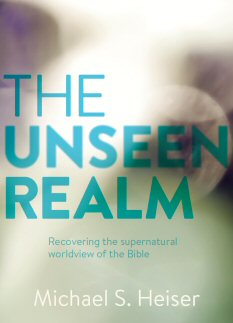
The Unsee Realm - A Review


The Unseen Realm


by
Michael S. Heiser

A Review

I know that many are fans of Michael Heiser. I am not. That is not because I have a problem with him or his writing, I just am not familiar with him. I do not have enough knowledge of his work to be or not to be a fan. Having said that, I found the current volume to be a significant improvement to his earlier work, I Dare You To Bore Me With The Bible.

As I read the current work, I felt as if the author had access to my previous review prior to writing this book. Such concerns as a lack of an index (this book has two, including a Subject Index and a Scripture Index). References and footnotes are provided throughout the text. In addition, a companion website provides additional bibliographic materials. The companion website also contains a discussion guide - which delves more deeply into the topics covered in the text.

Having been trained in the sciences, where most textbooks include discussion questions and problem sets allowing the student to check their understanding of the topics, I have often wondered why there are not similar pages in the texts for other disciplines - including theology. Though not a standard adopted by publishers, this would appear to be the major lapse in the current text (and most theological texts). That fact notwithstanding, the current book is worth the time spent reading, considering, and responding to its contents. I would encourage many to take the time to partake of the author’s thought and conclusions.
______________

This review is based on a free electronic copy provided by the publisher for the purpose of creating this review.  The opinions expressed are my own.

Wednesday, February 4, 2015

The Bible's Answers to 100 of Life's Biggest Questions - A Review


A Review


I first met Norman L. Geisler 40 years ago as a student during my first semester at Trinity Evangelical Divinity School. The course was “Introduction to Apologetics”. I have seen and read a few of his books over the years, but this is the first book I have had the opportunity to review.


This book provides, as the title implies, answers to 100 questions. The answers are succinct, limited to one or two pages. They include THE answer, scripture, and external resources (e.g. web pages or videos) supporting the author’s view. Though most of the questions are theological in nature, each does include a one or two sentence statement as to why the question and its answer has application to our Christian lives. With few exceptions, only the last ten questions are directly related to the more practical side of life. Regardless of the question asked, Geisler does add his expected scholarly, thoughtful approach in answering each one. The reader will grow as he makes his or her way through the book - whether you agree or disagree with the author’s answers.


The order of the questions moves from very broad questions (e.g. “1.  What is Truth?”) toward more narrow questions:


10.  How Did the Universe Come to Be?
19.  Who is Jesus Christ?
32.  What is the Gospel?
67.  Does God Hear My Prayers?
73.  Is Abortion Murder?
95.  Why Are So Many Young People Abandoning the Faith?


From a philosophical perspective, this order makes sense. But for the unbeliever or new Christian, it may have helped to start with more specific questions and move on to the deeper, more specific, questions as one moved through the book.


Though I appreciate the book’s responses to the questions, I would much prefer a more balanced approach. An opportunity to study the multiple responses that believers have given to the various questions would strengthen the book. The authors attempt to give “THE” answer to each question, with little room for the reader to discover truth for themselves. Having said that, the writers do seem to strike a middle ground that might be more satisfying to many. For example, when asked, “Did God Pick Me or Did I Choose Him?”, the authors begin by stating that, “Throughout the pages of Scripture, the doctrine of free choice is repeatedly demonstrated …” However, they conclude by stating, “Finally, God chose us before we chose Him …” Similarly, when answering the question, “Can I Lose My Salvation?”, the authors reply, “Of all the questions, this one has certainly sparked some of the biggest debates in the church, and it is often to blame for much of the division among denominations.” However, they go on to write, “There are several reasons Christians can’t lose their salvation...”


I don’t question that the author’s can write the book they want to write; yet the reader must know that the authors are feeding answers, not helping the student discover the answers. This book presents a one-sided response, the true student will want to find other resources which present alternate answers. Geisler and Jimenez do contribute to the discussion. But the discussion must continue till we reach heaven and God gives us THE answers, HIS answers.
______________

This review is based on a free copy provided by the publisher for the purpose of creating this review.  The opinions expressed are my own.